


phpAfterShell on CentOS 7 has no fix from anyone upstream: CVE-2026-126714 is patched only in PHP 8.2.36, 8.3.37, 8.4.28 and 8.5.13, and CentOS 7 servers get none of those from their usual repositories. GetPageSpeed ships the fix for every PHP a CentOS 7 server can run, from the stock 5.4 to 8.5, in both package shapes. Install it from the channel for your version and restart PHP-FPM.
Patched for PHP2Shell in October? That does not cover this one. Paste your package list into the phpAfterShell checker: it reads distro backports and tells a PHP2Shell-only build from one with both fixes. The other fixes in the same release are listed in PHP Security Release November 2026.

CVE-2026-126714  RCE via partially overwritten session files  (GHSA-fm2m-fjf5-v3cp)  CVSS v4.0 9.2
Name:            phpAfterShell (depthfirst, November 19, 2026)
Affected:        every PHP before the fixed releases; the code dates back to PHP 4.1
Fixed upstream:  8.5.13, 8.4.28, 8.3.37, 8.2.36 only
CentOS 7 fix:    GetPageSpeed channels php54 php56 php70 php71 php72 php73 php74 php80 php81 php82 php83 php84 php85
How to fix phpAfterShell on CentOS 7
CentOS 7 servers run PHP in one of two package shapes, and GetPageSpeed ships both for every version. Check which one you have:
rpm -qa 'php*-common' --qf '%{NAME}-%{VERSION}-%{RELEASE}\n'
Base-name packages (php-common-7.4.33-...) replace the system PHP. Upgrade them from the channel for your version:
yum -y install https://extras.getpagespeed.com/release-latest.rpm
yum --enablerepo=getpagespeed-extras-php74 upgrade 'php-*'
systemctl restart php-fpm
Replace php74 with your version, from php54 to php85. Enable the channel only for the transaction, as shown: each channel carries base-name php of its own version.
Stock CentOS 7 PHP 5.4 (php-common-5.4.16-48.el7, the PHP that CentOS 7 shipped) upgrades in place to a patched 5.4.45-29.el7 with the same package names and configuration files. Include the mod_php package php in the upgrade:
yum -y install https://extras.getpagespeed.com/release-latest.rpm
yum upgrade php 'php-*'
systemctl restart httpd
Software collections (php74-php-common-7.4.33-...) live side by side under their own names. Their builds are in the always-enabled main repository, so no channel is needed:
yum -y install https://extras.getpagespeed.com/release-latest.rpm
yum upgrade 'php74-php*'
systemctl restart php74-php-fpm
For the other collections, replace php74 with php54 through php85 in all three places. Running Apache mod_php? Restart httpd instead of PHP-FPM. Running workers keep the old code in memory until they restart, so the restart is part of the fix.
What phpAfterShell is
The PHP project published the advisory for CVE-2026-126714 on November 19, 2026, as part of a release with 17 security fixes. The security firm depthfirst, which found the flaw, named it phpAfterShell.
PHP’s default session handler keeps each session in a file. Before the fix it wrote new session data over the old file and cut the file short only when the new data was shorter. If that write was interrupted, the file could keep the start of the new session followed by the end of the old one. PHP reads a session file as a list of records, so leftover bytes that an attacker placed in an earlier session can be read as serialized objects, and PHP creates them on the next session_start().
Three things have to line up:
- Session storage in files. This is the default.
- A way to put chosen bytes into a session. Session upload progress, on by default until the November release, gives an unauthenticated visitor one. An application that stores large user-supplied strings in a session gives another.
- A write that fails part-way. The PHP project describes a hard memory-limit failure in threaded builds, and the researchers report an out-of-memory kill.
The sources disagree on one point. The PHP advisory says a suitable gadget chain in the application is needed to turn this into code execution. depthfirst reports a full chain that needs no application class. Plan for the worse case.
No exploitation in the wild had been reported on November 20, 2026.
A PHP2Shell patch does not fix phpAfterShell
PHP2Shell (CVE-2026-109618 and CVE-2026-109619) and phpAfterShell are separate flaws with separate fixes. The October fix restricted what PHP may do while it tracks an upload. It left the session file write unchanged.
What that means on CentOS 7:
- A Remi build (release ending in
.el7.remi) has neither fix. Remi stopped building for CentOS 7 in June 2024. - A GetPageSpeed build from October or early November has the PHP2Shell fix only. On PHP 5.4 to 8.1 those builds also switch session upload progress off in the code, which closes the easiest route to phpAfterShell. The session file write is still the old one, so upgrade.
- A GetPageSpeed build from November 19 or later has both. The table below lists the first one for each PHP version.
One detail can mislead a check: on the PHP 5.4 to 8.1 builds, php -i still shows session.upload_progress.enabled => On. The feature has been off in the code since the October build, whatever the setting says.
Why phpAfterShell on CentOS 7 has no vendor fix
The PHP project fixed only the supported branches. PHP 8.1 and older are end of life and got no release.
This is what the vendors’ own trackers showed on November 20, 2026. It is a record of that day, not a live feed:
- Red Hat listed PHP on RHEL 7, 8, 9 and 10 as affected and had released no fixed package (tracker). On RHEL and CentOS 7, the GetPageSpeed packages in this article carry the fix.
- Remi released 8.2.36, 8.3.37, 8.4.28 and 8.5.13 for Enterprise Linux 8 and newer. There is no Remi build for CentOS 7.
- Debian fixed bookworm and trixie. Ubuntu fixed 16.04 and 18.04 for Ubuntu Pro subscribers and listed the newer releases as needing triage. Neither helps a CentOS 7 server.
So a CentOS 7 host has the same three options it had in October: rebuild PHP from source with a hand-ported patch, move to a vendor whose packages use different names and paths, or install a drop-in build.
The stopgap is partial
If you cannot upgrade today, switch session upload progress off in php.ini or the pool configuration, then restart PHP:
session.upload_progress.enabled = 0
Three limits apply:
- Set it in the server configuration. A call to
ini_set()from the application runs too late. - It closes the easiest route only. The PHP project notes that an application which stores large user-controlled strings in a session can reach the same defect without upload progress.
- Sessions kept in Redis or a database are not affected by the file-write defect. Moving session storage is a bigger change than the upgrade.
The GetPageSpeed fix for each PHP version
Every build that fixes phpAfterShell on CentOS 7 is drop-in compatible with the Remi package layout: the same package names, extension ABI and configuration files, so yum upgrade swaps them in place and PECL extensions keep loading. Each version has its own page with the full list of security fixes it carries.
| PHP | Base-name channel | First build with the fix (both shapes) |
|---|---|---|
| 5.4 | getpagespeed-extras-php54 |
5.4.45-29.el7 |
| 5.6 | getpagespeed-extras-php56 |
5.6.40-54.el7 |
| 7.0 | getpagespeed-extras-php70 |
7.0.33-56.el7 |
| 7.1 | getpagespeed-extras-php71 |
7.1.33-46.el7 |
| 7.2 | getpagespeed-extras-php72 |
7.2.34-41.el7 |
| 7.3 | getpagespeed-extras-php73 |
7.3.33-35.el7 |
| 7.4 | getpagespeed-extras-php74 |
7.4.33-45.el7 |
| 8.0 | getpagespeed-extras-php80 |
8.0.30-32.el7 |
| 8.1 | getpagespeed-extras-php81 |
8.1.34-16.el7 |
| 8.2 | getpagespeed-extras-php82 |
8.2.36-1.el7 |
| 8.3 | getpagespeed-extras-php83 |
8.3.37-1.el7 |
| 8.4 | getpagespeed-extras-php84 |
8.4.28-2.el7 |
| 8.5 | getpagespeed-extras-php85 |
8.5.13-2.el7 |
PHP 8.2 to 8.5 are the upstream fixed releases, built for CentOS 7. PHP 5.4 to 8.1 carry the upstream change as a backport: PHP now empties the session file before every write, and fails the write if it cannot. The same builds carry the rest of the November 19 release.
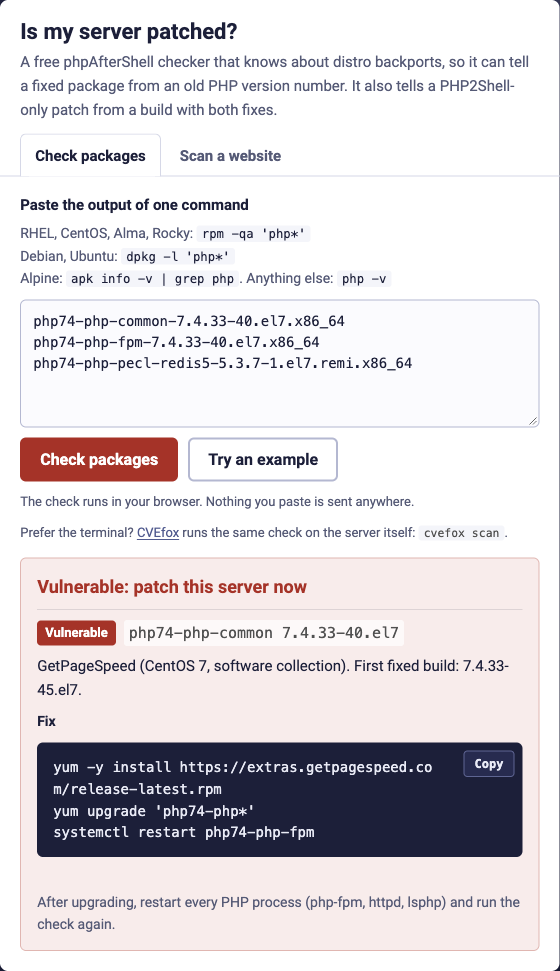
Check whether your server is patched
To confirm that phpAfterShell on CentOS 7 is fixed on a server, list the installed builds and compare the release with the table above:
rpm -qa 'php*-common' --qf '%{NAME}-%{VERSION}-%{RELEASE}\n'
A fixed build names the CVE in its changelog:
rpm -q --changelog php-common | grep CVE-2026-126714
- CVE-2026-126714 (GHSA-fm2m-fjf5-v3cp): session files are always truncated before a write (partially overwritten session file RCE)
No output means the fix is not installed. Only have php at hand, not rpm? GetPageSpeed builds print their exact release in php -v:
PHP 7.4.33 (cli) (built: Nov 19 2026 15:09:04) ( NTS )
Copyright (c) The PHP Group
Built by GetPageSpeed LLC (7.4.33-45.el7)
Prefer a one-command check? CVEfox, the free GetPageSpeed scanner, reads every installed PHP package and prints the exact fix:
yum -y install https://extras.getpagespeed.com/release-latest.rpm
yum -y install cvefox
cvefox scan
On a CentOS 7 server one build behind, it reports this:
[VULNERABLE] GetPageSpeed (CentOS 7): php-common 7.4.33-44.el7
  First fixed build: 7.4.33-45.el7
  12 of 69 CVEs tracked for PHP 7.4 are open on this build.
  Open: CVE-2026-15353, CVE-2026-126714, CVE-2026-127960, CVE-2026-128064, CVE-2026-128090 and 7 more
  Fix: yum -y install https://extras.getpagespeed.com/release-latest.rpm
       yum --enablerepo=getpagespeed-extras-php74 upgrade 'php-*'
       systemctl restart php-fpm
After the upgrade the same scan reports every tracked CVE for PHP 7.4 as fixed.
Rollback and caveats
yum downgrade returns you to the previous build if you ever need to.
The fix changes one behaviour: a session write now fails with a warning if the file cannot be emptied first, where PHP used to carry on. On a healthy filesystem you will not see it.
CentOS 7 itself is still end-of-life. These channels keep the PHP layer patched; they do not make the operating system supported. Everpatch for CentOS 7 covers the rest of what GetPageSpeed maintains for EL7. Plan the migration, but don’t run exposed in the meantime.
FAQ
Is PHP 7.4 on CentOS 7 affected by CVE-2026-126714?
Yes. Every PHP before 8.2.36 is affected, and PHP 7.4 got no upstream release. For the php74 software collection, install the GetPageSpeed release package and run yum upgrade 'php74-php*'. For a base-name install run yum --enablerepo=getpagespeed-extras-php74 upgrade 'php-*'. The first fixed build is 7.4.33-45.el7.
I patched PHP2Shell in October. Am I covered?
No. phpAfterShell is a separate flaw. A GetPageSpeed build from October has the PHP2Shell fix and, on PHP 5.4 to 8.1, session upload progress switched off, which closes the easiest route. The session file write itself is fixed only in the builds from November 19.
Is setting session.upload_progress.enabled=0 enough?
No. It closes the easiest route, and only when set in php.ini or the pool configuration. An application that stores large user-controlled strings in a session can still reach the defect.
Do I need a subscription to fix phpAfterShell on CentOS 7?
Not for personal, development or evaluation use: the packages install from the public GetPageSpeed repository with no signup. Commercial production use requires GetPageSpeed Ultra ($500/year, up to 10 servers running your own services) under the repository terms: it funds these backports and keeps your servers covered for the next EOL PHP CVE. Administering servers for clients, or more than 10? GetPageSpeed Fleet starts at $800/year.
Is phpAfterShell being exploited?
No exploitation had been reported on November 20, 2026, and the researchers withheld the last stages of their exploit. PHP2Shell was attacked within days of its disclosure, so do not wait for reports.
Conclusion
phpAfterShell on CentOS 7 is a critical PHP flaw with no upstream or distribution fix for the PHP versions these servers run. The GetPageSpeed channels close that gap for every PHP from 5.4 to 8.5, in place and free to install.
Running these servers for a business? Commercial production use requires GetPageSpeed Ultra ($500/year, up to 10 servers). Two critical PHP releases landed within a month, and each one has to be ported again to branches upstream abandoned years ago. Ultra funds that work and tells you when the next fix is ready for the PHP your servers run.